

Discount and Rebate
Discount and Rebate: Overview
This topic covers concepts such as rebate, marked price (MP) of an item, discount on sale of an item, finding amount of discount given as percentage, and conversion of fractional numbers to percentage.
Important Questions on Discount and Rebate
A shopkeeper marks his goods above the cost price, but allows discount for cash. What per cent profit or loss does he really make?

The price of a spider toy is inclusive tax (under GST) at the rate of on its listed price. A buyer asks for a discount on the listed price, so that after charging GST, the selling price becomes equal to the listed price. If the amount of discount which the seller has to allow for the deal is , then find the value of .
Charan scored marks out of in his maths exam. What is percentage of marks did he score?
Paras scored marks out of in his fourth class exam. What is the percentage of marks did he score?
From the options listed below, choose the formula to calculate the profit percentage.
(Consider CP = Cost Price, SP = Selling Price, MP = Marked Price, D = Discount and P = Profit)
A bicycle seller procured a cycle at a cost of ₹6,500 and marked its price tag with ₹8,200. How much profit could the seller make if he allows 10% discount to the customer?
The marked price of a bicycle is ₹8,200 and the seller offers a discount of 10%. What is the selling price of the bicycle?
Look at the figure below and and answer the question that follows.

What is the producer’s selling price?
Referring to the original question, Shopper’s selling price = ₹80 – 18.75% of ₹80 =₹65. What is distributor’s selling price?
Analyse the original question further, we get producer’s selling price = distributor’s cost price. Also distributor’s profit percentage = 30%. If selling price is known then the cost price can be calculated using a formula that connects the cost price, the selling price and the profit percentage.
Identify the formula.
The original question was: “A producer fixed the maximum retail price (MRP) of 1L juice as 2.5 times of its production cost. The juice was then sold to a distributor, who booked 30% profit when sold to a shopkeeper. The shopkeeper gave 18.75% discount to the customer and made a profit of 25%. If the MRP of 1L juice was ₹80, then profit percentage of the producer was _____________.”
Analyse the question and choose the right option based on the ‘set of data we have’ and ‘the set of data we need’ to find producer’s profit percentage.(CP and SP are producer’s cost and selling prices)
Choose the correct equation to find the profit made by the travel agency.
(Use the data as needed, from the original question.)
Choose the correct equation to find the selling price of the ticket.
(Use the data as needed, from the original question.)
Choose the correct equation to find the discount given to the customers.
(Use the data as needed, from the original question.)
Let’s refer a part of original question, “A travel agency increased the cost of tickets by 15% and then offered a 10% discount on the purchase of the tickets”.
Which of the following equation is true about the marked price of the ticket?
Clara purchased a packet of chips.
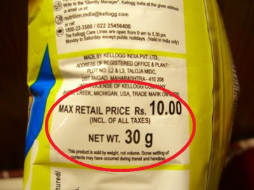
Which of these statements is correct based on the picture given above?
Under which of these situations can we definitely get discount?





























