

The Principle of Superposition of Waves
Important Questions on The Principle of Superposition of Waves
(a) Explain what is meant by the term superposition.

(a) Copy the waves shown in the diagram onto a sheet of graph paper and use the principle of superposition to sketch the resultant wave.
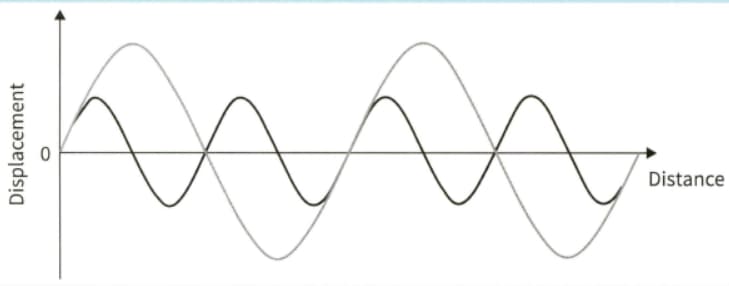
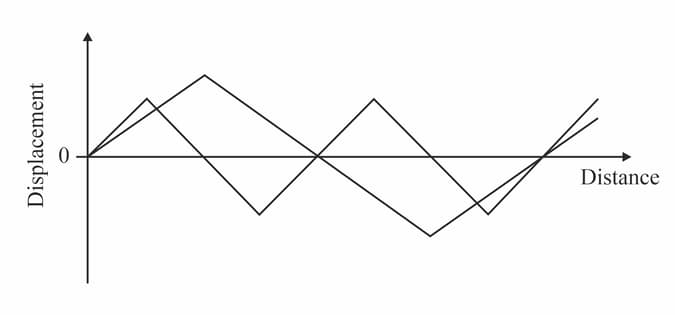
On graph paper, draw two 'triangular' waves similar to those shown in Figure. (These are easier to work with than sinusoidal waves.) One should have wavelength and amplitude . The other should have wavelength and amplitude
Use the principle of superposition of waves to determine the resultant displacement at suitable points along the waves, and draw the complete resultant wave.
Knowledge of phase difference is vital in understanding how waves combine in space-remind yourself by writing down the phase difference of two particles oscillating in step, and two particles oscillating in antiphase.
Can you recall the general properties 'of waves, including electromagnetic waves? Write down as many properties as you can remember.





























