


Write the number of sample space for rolling two dice using tree diagram.

Important Questions on Probability
Four cards marked A, B, C and D are in a container. A card is drawn, the letter noted, and then it is replaced. Another card is then drawn and the letter noted to make a two-letter combination. Draw a tree diagram to show the sample space in this experiment.

Four cards marked A, B, C and D are in a container. A card is drawn, the letter noted, and then it is replaced. Another card is then drawn and the letter noted to make a two-letter combination. What is the probability of getting the letter combination BD?
Sandra has a bag containing three coloured counters: red, blue and green. How many possible outcomes are there for the two draws?
James wants to find the probability of rolling two sixes on two fair dice.
He starts to draw this tree diagram.
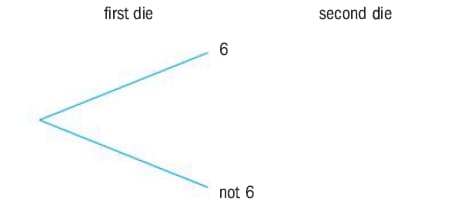
Copy and complete the tree diagram.
Calculate the probability of rolling two sixes.
Sandra has a bag containing three coloured counters: red, blue and green.Draw a tree diagram to show the possible outcomes when one Counter is drawn from the bag at random, then returned to the bag before another counter is drawn at random.
Sandra has a bag containing three coloured counters: red, blue and green. How many outcomes produce two counters the same colour?
Sandra has a bag containing three coloured counters: red, blue and green. How many outcomes do not contain the blue counter?
Four cards marked A, B, C and D are in a container. A card is drawn, the letter noted, and then it is replaced. Another card is then drawn and the letter noted to make a two-letter combination. How many outcomes are in the sample space?
Two fair coins are tossed.
Draw a tree diagram to represent the possible outcomes.
Write the sample space for tossing three coins using tree diagram.
Sandra has a bag containing three coloured counters: red, blue and green. How many outcomes contain at least one blue counter?





























