

Classification of Living Organisms and Binomial Nomenclature
Classification of Living Organisms and Binomial Nomenclature: Overview
This Topic covers sub-topics such as Five Kingdom Classification, Biological Nomenclature, Notochord, Hierarchy of Classification, Body Cavity, Symmetry in Organisms, Basis of Classification of Living Organisms and, Phylum as a Taxonomic Rank
Important Questions on Classification of Living Organisms and Binomial Nomenclature
What do you understand by phylum?

What is body cavity ?
Study the below figure and identify the taxonomic rank labelled as 'Y':

State differences between taxonomic rank:
Order and class
Order is the assemblage of classes that exhibit a few similar characters.
Name the taxonomic category that includes related orders.
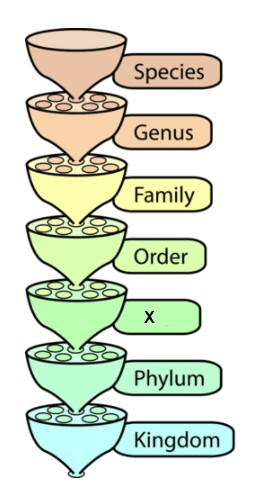
Study the figure given above, identify 'X' and explain this category in your own words:
Study the given figure and identify which taxonomic rank 'X' indicates:
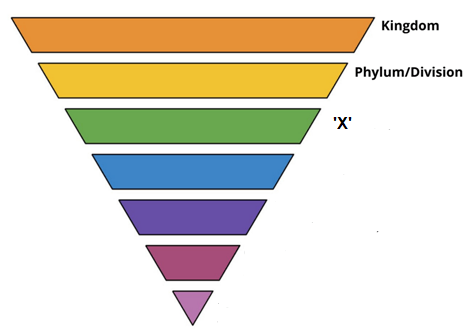
Identify whether the given statement is true or false:
Class category includes related phylum.
Which of the following is an example of phylum/or division?
Homo sapiens belongs to the class Chordata.
Homo sapiens is the scientific name of the human beings in which 'Homo' represents
Write 'true' or 'false'. If false, write the correct statement.
A genus is made of families.
The scientific name of human beings is Homo _____.
Name the five kingdoms according to the new classification.
Rearrange the following categories of classification in their proper sequence starting with the highest. species, family, genus, class, order, phylum.
What is notochord?
The group of population which are capable of interbreeding is called _____.
Who proposed the five-kingdom system of classification of organisms? (Linnaeus/Whittaker)
_____ in the taxonomic hierarchy has the smallest number of organisms with maximum number of similar characters.





























