

Reflection and Laws of Reflection of Light
Reflection and Laws of Reflection of Light: Overview
This topic covers concepts such as Reflection, What Makes Things Visible, Incident Ray, Angle of Incidence, Angle of Reflection, Laws of Reflection, Beam of Light, Normal to the Plane Mirror, Reflecting Surfaces, Periscope, etc.
Important Questions on Reflection and Laws of Reflection of Light
List a few examples of reflecting surfaces used in daily life.

We can see the reflection of nature in water.
Why do we see a reflection in water?
How do we see reflection of trees and buildings in water?
The surface of water can reflect light.
Name the property of light by which it always travels in straight lines.
(Choose from: Rectilinear propagation/Interference)
Observe the adjacent figure. AB and BC are two plane mirrors arranged at . A ray incident at angle at AB. Find the value of 'x'.
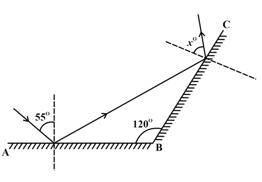
The angle of reflection is equal to angle of incidence when the light ray gets reflected from a smooth surface.
Name the type of mirror used in a periscope.
A periscope works on the principle of _____ of light from plane mirrors.
Light changes its _____ (direction/ speed/ frequency) when it is obstructed by any object, and it is called reflection.
In a periscope, the angle between the plane mirrors and the ends of periscope is:
The incident ray, normal and reflected ray all lie in different planes.
The incident ray, normal and reflected ray all lie in the same _____.
If an incident ray makes an angle of degree with a plane mirror, then the angle of reflection will be _____ degree.
If the angle of incidence is _____ the incident ray strikes the surface normally.
The angle between the reflected ray and the _____ is called the angle of reflection.
At the point of incidence, incident and reflected rays make _____ angle with the reflecting plane surface.
State the two laws of reflection.
Define incident ray and reflected ray.





























